Onam Advertising Ideas Kerala 2026: Activate Outdoor First, Then Digital
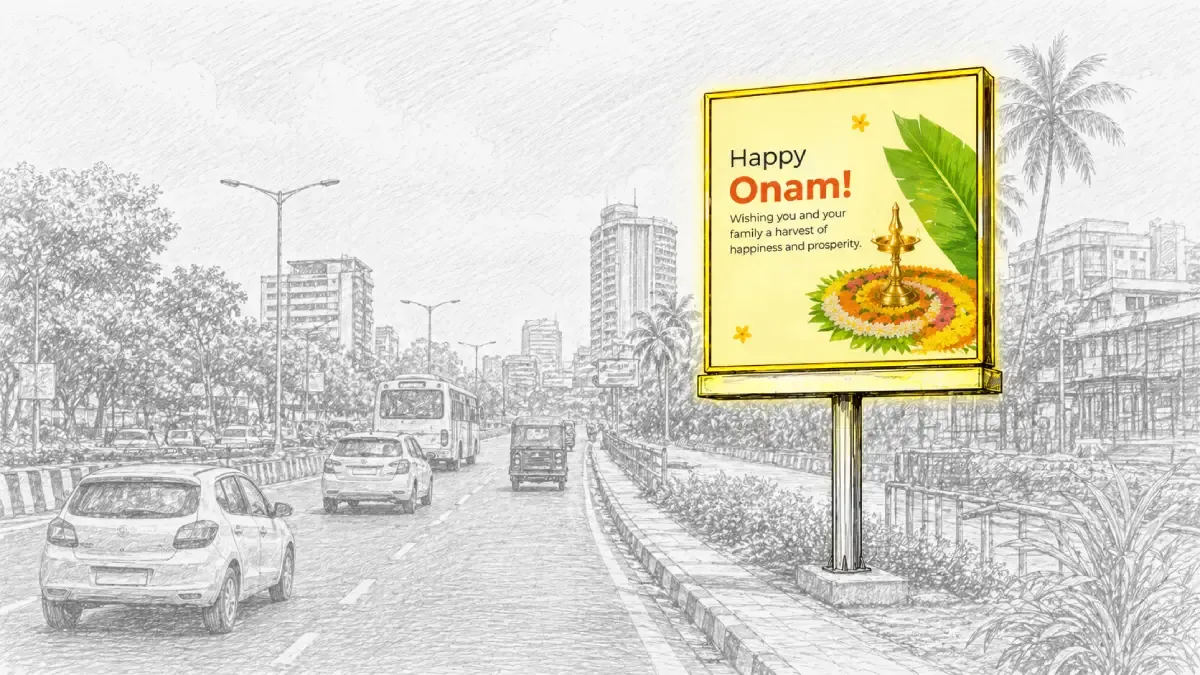
For Onam 2026 in Kerala, the media plans that consistently outperform are not running larger budgets; they are running earlier ones, in the right sequence. Most onam advertising ideas for Kerala centre on channel mix and allocation; the sequencing decision (which medium activates first, and by how much lead time) determines whether those channels amplify each other or simply overlap in August.
The Standard Onam Media Plan Has a Sequencing Error
The conventional structure: outdoor, digital, and television activating in roughly the same August window, each delivering reach against the peak purchase period. The logic is defensible: maximum presence during maximum intent. The problem is that it treats DOOH as a reach medium, which is not what DOOH does best.
Physical screen exposure before digital activation produces measurably higher recall on the channels that follow. A 2023 neuroscience study by Ocean Outdoor and Neuro-Insight (138 participants, brain responses measured in real time across London and Manchester) found brand approach lifted 87% in the London cohort when DOOH exposure preceded social media content versus a non-primed audience. The reason is attention quality: physical environments produce a different kind of brand encoding than scroll-based digital contexts.
A consumer who sees your creative on a DOOH screen during the late July commute processes a Meta ad for the same brand in early August as reinforcement, not introduction. A 2018 IPA Databank analysis by Peter Field and Rapport found OOH amplifies social media performance by 20% when both channels run together. Without the outdoor-first activation, that amplification doesn’t materialise. The digital campaign is introducing the brand into a crowded inventory window and paying introduction rates for it.
The sequencing principle: DOOH activates first, 3 to 4 weeks before digital goes live. This is not an outdoor-first argument. It is a digital performance argument.
What the 2025 Onam Adex Numbers Actually Tell a Planner
Onam 2025 total advertising spend across Kerala reached an estimated ₹1,100 crore, up 15–20% from 2024, according to Ramsai Panchapakesan of Havas Media India. Commercial sales for the season were estimated at ₹12,000–13,500 crore across jewellery, electronics, FMCG, and automobiles.
The channel split is more useful than the headline number for planning decisions:
- Digital (social, YouTube, OTT, e-commerce): 40–45% of campaign budgets (Carat India)
- Malayalam GECs: the largest single medium; Onam accounts for 20–24% of annual GEC revenue (Havas Media India)
- OOH (outdoor, including DOOH): approximately 8–10% of budgets in Kochi and Thiruvananthapuram, with clear recovery momentum, per Ratnakar Bharti, VP Media at Mudramax
- Print: retains relevance in jewellery, real estate, and education
- Radio: approximately 4–6%
When 40–45% of the market is competing for the same social and OTT inventory in a six-week window, CPMs rise and audience fatigue follows. Physical screens reach people outside that competition. The brand with confirmed outdoor presence is accessing an audience that digital-only competitors are not.
The OOH recovery figure is also a planning signal. The Pitch Madison Advertising Report 2025 recorded India’s OOH market growing 12% to ₹4,650 crore, with DOOH and transit formats outpacing traditional outdoor. In Kerala, that translates to more demand for the same premium corridors, not more supply.
What the 2025 data implies for 2026: The brands best placed to use DOOH as a digital amplifier are the ones that confirmed their placements before July CPM pressure began.
Why Kerala’s Screen Geography Makes the Sequencing More Measurable
Kerala’s DOOH coverage spans defined commercial hubs, not scattered low-footfall sites. LDX’s network covers nine districts from Thiruvananthapuram to Kannur: Ernakulam’s commercial core in Kochi, Kozhikode city, Thiruvananthapuram’s East Fort corridor, and district commercial centres across the state. That defined footprint makes the sequencing approach practical in a way it wouldn’t be in a fragmented screen market.
In a fragmented screen market, building a predictable audience exposure pool around outdoor placements is difficult. In Kerala, defined screen locations mean brands can map geo-targeted mobile retargeting against a known physical perimeter, serving mobile ads to devices in zones where DOOH exposure has already occurred. The audience pool is defined by physical presence, not digital browsing signals.
Why this matters for Onam specifically: Consumer electronics is Kerala’s most Onam-concentrated category. The festival drives the bulk of annual appliance and device sales in the state. Purchase consideration in that category builds from late July. A brand with screens live in these commercial hubs from late July is reaching high-intent audiences before digital CPMs have moved.
Kerala’s defined screen locations make the priming sequence more predictable here than in most Indian markets. The commercial hubs that matter for Onam reach a definable audience, and that audience can be followed into mobile.
The Onam 2026 Campaign Timeline: Four Decisions, Not Milestones
Translated into a planning calendar, the sequencing principle looks like this:
April–May: Lock strategy and write the outdoor brief Confirm channel mix, creative territories, and geographic priorities. Write the outdoor brief with placement logic (which corridors, which audience clusters) so creative is eventually built against specific screen environments, not a generic outdoor spec.
June: Confirm outdoor inventory For premium DOOH and hoarding positions across Kochi and Kerala’s major commercial centres, June is the operational deadline. High-footfall corridors attract heavy demand from jewellery and electronics brands, both of which run heavy Onam campaigns and treat outdoor as their primary awareness medium. Arriving in July means negotiating for remaining positions.
Late July: Activate outdoor first Screens go live. Consumer attention is shifting toward Onam purchases but digital competition has not yet peaked. This is the priming window: building brand recognition in the physical environment before Meta and Google CPMs move.
Early August: Activate digital into primed audiences Meta, Google, YouTube, and OTT campaigns go live. Audiences along the major corridors have already encountered the outdoor creative. Digital is closing a loop, not opening a conversation.
Book outdoor by June. Activate screens by late July. Let digital follow, not lead.
Onam Advertising Ideas for Kerala: Three Execution Decisions
Three execution choices consistently produce better results for brands running DOOH as part of the Onam mix:
Run Malayalam creative on regional screens. DOOH allows language-specific executions per screen without physical reprint costs. In Kozhikode and Thiruvananthapuram, Malayalam-language creative lands with stronger local resonance than English-only executions. A national jewellery brand running a Malayalam-language CTA on Thiruvananthapuram’s East Fort corridor (where Onam jewellery footfall concentrates) is not translating a national campaign; it is signalling presence in the specific market that buys. The production cost is low; the brand perception benefit is not.
Update creative as the festival window progresses. Screens can swap creative without production overhead. For an electronics brand (Kerala’s most Onam-concentrated category), a practical three-phase rotation: brand awareness from late July when consideration opens, a product-specific execution in the first two weeks of August as intent builds, and a closing message in the final week before Thiruvonam when purchase decisions are being made. That is three executions briefed once in April. Without the rotation brief upfront, you run five weeks of the same awareness message into an audience whose buying intent has already peaked.
Layer geo-targeted mobile behind outdoor placements. Kochi’s commercial corridor (Ernakulam through Aluva and Angamaly) carries dense pre-Onam traffic, and Kozhikode and Thiruvananthapuram add significant commercial footfall across the network. A brand with DOOH screens across those locations can pair placements with geo-targeted mobile advertising, reaching the same audience on their phones after outdoor exposure. This is the most measurable physical-to-digital amplification sequence available in Kerala today.
The brief implication: These three decisions belong in the channel brief in April, not the production brief in July. By then, the window to design around them has closed.
The Brief That Needs to Change
Premium outdoor positions for Onam fill before the season feels urgent to most planners. The brief that arrives first is the one that can be designed around confirmed screen environments, not built around whatever inventory remains.
The Onam campaigns that outperform in August are not the ones with the largest budgets. They are the ones where outdoor was treated as an input to the digital strategy: placements confirmed, creative briefed against specific screen environments, geo-targeting mapped before the season opens.
If you’re building an Onam 2026 plan and want to understand how DOOH fits into the sequence (which Kerala corridors, what lead times look like this year, how to structure the outdoor-first activation), talk to the LDX Media team. The earlier you’re in the conversation, the more the plan can be designed around confirmed placements.
Frequently Asked Questions
When is Onam 2026?
Onam 2026 runs from Atham on August 16 to Thiruvonam on August 26. The commercial shopping window opens earlier: late July for electronics and consumer durables, early August for jewellery and apparel.
How large is Onam as an advertising season in Kerala?
Onam 2025 adex reached an estimated ₹1,100 crore, up 15–20% year-on-year. For planning purposes, the more relevant number is the channel split: digital took 40–45% of budgets, Malayalam GECs took the largest single share, and OOH accounted for 8–10% of Kochi and Thiruvananthapuram spend, with clear upward momentum.
When should we book outdoor inventory for Onam 2026?
June is typically the last window to confirm premium positions in Kochi; April–May if you want confirmed placements with time to build creative around specific screen environments. June means inventory is still available. In competitive years, high-footfall positions go earlier. April–May means your plan can be designed around where the screens actually are.
Where does DOOH fit in an Onam media plan?
DOOH activates 3–4 weeks before digital. That lead time is the campaign design decision: confirm outdoor placements first, then build digital targeting around where the screens are and who passes them. The media plan is more integrated if outdoor informs the brief, not the other way around.
Which categories dominate Onam advertising spend in Kerala?
Jewellery and electronics dominate, followed by FMCG, automobiles, real estate, and BFSI. The sequencing implication differs by category: jewellery’s purchase cycle is longer (outdoor from late July makes sense); electronics buyers move quickly around Thiruvonam itself (late August digital + retargeting is often more efficient). Brief outdoor and digital on different timelines per category if your client runs both.
Outdoor booking for Onam 2026 is open now. Talk to LDX Media before the window closes.