Why Outdoor Advertising in Kerala Works Differently, and Why It Should Shape Your Next Campaign
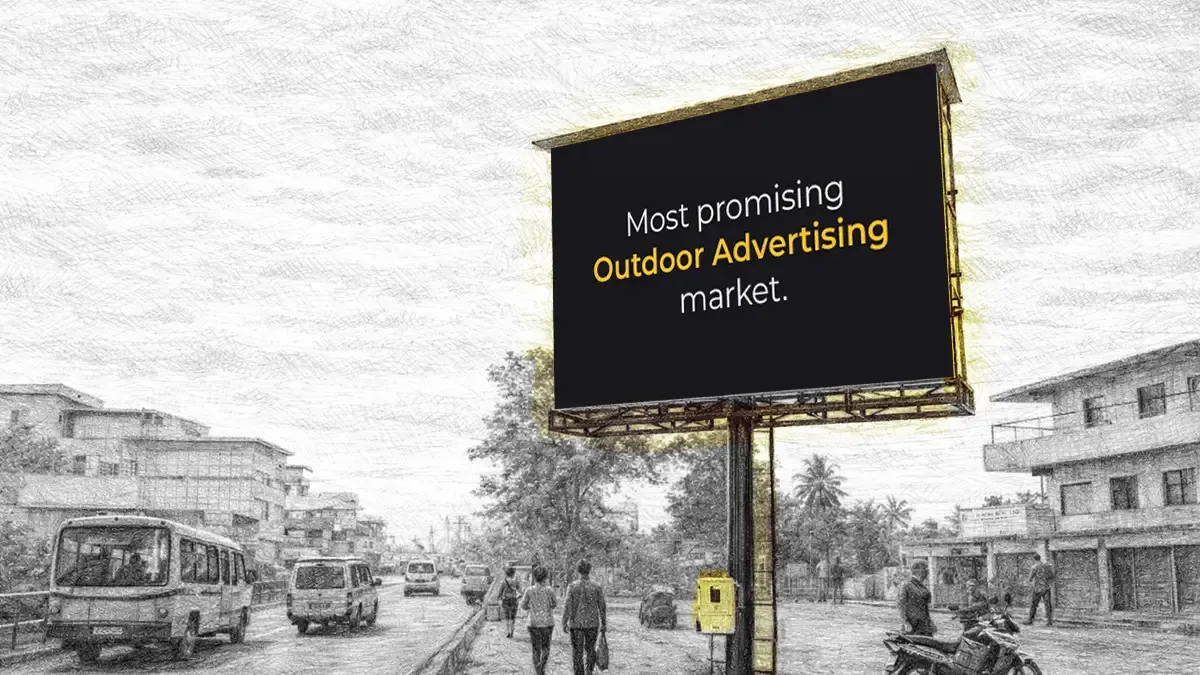
Kerala is one of the few Indian states where outdoor advertising can carry specific copy and have it land. The audience reads billboards rather than just registering them, has more disposable income than per-capita GDP suggests, and travels through corridors narrow enough that the same screen reaches the same commuter every weekday. Most national media plans still treat it as a line item in a south India buy.
That allocation underprices what this market actually delivers.
Kerala’s consumer profile gives outdoor advertising unusual leverage
Kerala’s literacy rate of 96.2% (NSS 75th Round, 2017–18), the highest in India, changes what outdoor advertising can accomplish. In markets with lower literacy, a billboard is primarily a visual stimulus: colours, logos, brand recall through repetition. In Kerala, high literacy means outdoor creative gets read rather than just glimpsed. Headlines register. Body copy gets processed. A well-written outdoor brief can carry a specific claim or offer here in a way that would not be practical in most other Indian markets.
Layer on the NRI factor. 22 lakh Keralites currently work abroad, predominantly in the Gulf states, accounting for nearly 20% of India’s total inward remittance flow (RBI, 2024). That money doesn’t behave like a local salary. A Gulf-remittance household makes purchase decisions differently: it responds to premium positioning, takes its time on considered purchases, and tends to trust brands that build presence consistently. Outdoor advertising’s daily repetition fits that buying pattern better than one-off digital placements.
Kerala’s geography adds a third layer. The state is narrow (560 km long but only 35–120 km wide), with most commercial activity strung along the NH 544 and NH 66 corridors. Commuters don’t spread across wide urban grids the way they do in Delhi or Bangalore. The same people pass the same screens every day. Repeat exposure happens without engineering it.
Three corridors illustrate what concentrated Kerala OOH looks like in practice:
- Kochi’s Edapally–Kakkanad corridor: One of Kerala’s densest concentrations of IT professionals, corporate offices, and retail. The same high-value audience passes through this stretch on every commute, morning and evening, weekday after weekday.
- Thiruvananthapuram’s Technopark–city centre corridor: One of India’s largest IT parks sits alongside Kerala’s government centre. Professional and civil-service commuters share the same route daily; fewer alternatives means more consistent reach than you’d get in a more dispersed city.
- Kozhikode’s Mavoor Road: The main commercial artery of Kozhikode, with a different audience profile from Kochi, with distinct purchase categories and campaign timing, and one that most national plans underweight by stopping coverage at Ernakulam.
For digital out-of-home, this geography matters more than screen count: for a brand-building objective, a campaign on five well-placed screens along a primary corridor typically outperforms fifteen scattered across secondary roads on effective frequency.
The festival economy creates predictable, high-intensity advertising windows
Kerala’s retail calendar does not follow the national pattern. While most Indian advertising budgets peak around Diwali, Kerala’s largest retail season is Onam, a festival that builds across six to eight weeks through August and September. Jewellery, textiles, electronics, FMCG, and real estate all peak during this window. Brands that time their outdoor campaigns to this cycle capture audiences at their highest purchase intent.
But Onam is not the only window. Kerala’s advertising calendar has at least five distinct peaks:
Onam (August–September): Kerala’s largest retail season: jewellery, textiles, electronics, and FMCG brands compete across a six-to-eight week build-up.
Vishu (April): The second-largest retail window, anchored in gifting, electronics, and general retail.
Christmas and New Year (December–January): High commercial intensity in Kochi, Thrissur, and coastal towns. Retail, tourism, and hospitality brands are especially active.
NRI Return Season (May–June, November–December): Concentrated demand in real estate, gold, luxury goods, and automotive, categories where remittance-funded purchase decisions cluster.
School Admissions (March–May): Education, coaching, and EdTech brands targeting a concentrated parent audience during peak decision season.
Each window compresses months of category demand into a few weeks. The consumer who takes a month to decide on a purchase in February makes that call in days during Onam. A screen on the right corridor during the right window sits in front of active buyers, not passive audiences.
National media plans built around a Diwali-anchored calendar routinely underweight these windows. A Kerala-specific outdoor strategy captures all five.
Why digital screens are gaining ground in Kerala
Kerala’s outdoor advertising market has historically run on flex and vinyl hoardings. That is shifting. For a market with five seasonal peaks, the reasons are structural. Digital screens let you swap creative for each festival window without a new print run or installation. One screen, one booking, five different campaigns across five seasons. Traditional hoardings would require five separate print runs and five installations. Digital screens make that redundant.
India’s DOOH segment grew 78% year-on-year in 2024, with its share of total OOH revenues rising from 7% in 2023 to 12% in 2024 and 18% in 2025 (FICCI-EY M&E Reports, 2025/2026). Kerala’s corridor geography and five-peak calendar make it one of the better-positioned state markets to benefit from that shift.
We will publish a detailed, data-driven comparison of digital screens vs traditional hoardings separately.
What this means for brands and agencies planning Kerala campaigns
Kerala is not a difficult outdoor advertising market. It is a specific one, and the specificity works in your favour when you plan for it correctly.
The audience reads the copy and has income to spend on it. The corridors are narrow enough that frequency builds without needing screens across every district. And the calendar has five buying peaks; there’s rarely a quarter where outdoor isn’t ahead of demand somewhere in the state.
The brands seeing the best results here treat Kerala as a separate plan, not a percentage of a south India buy. They anchor to Onam rather than Diwali. They build corridor coverage rather than scatter placements. And they use digital screens to swap creative across seasonal windows rather than running the same execution for twelve months. Those conditions shape what a strong next campaign here actually looks like, and why it performs differently when you plan for them.
The structural case for outdoor advertising in Kerala does not rest on potential. It rests on what is already there, and what most national media plans are currently underpricing.
Planning a campaign? Contact our team to discuss campaign strategy and screen options for your Kerala campaign.
Frequently Asked Questions
How does Kerala’s outdoor advertising market compare to other south Indian OOH markets?
Kerala is differentiated on three dimensions most pan-south media plans underweight: a 96.2% literacy rate (NSS 75th Round, 2017–18, the highest of any Indian state) that makes copy-driven outdoor creative more effective than visual-only recall, remittance-funded disposable income that skews audiences toward premium categories, and a five-peak seasonal calendar that runs year-round. The state’s narrow corridor geography also means daily repeat exposure happens without engineering it. For brands running pan-south campaigns, these conditions make Kerala worth a dedicated outdoor plan, not a proportional share of a regional scatter buy.
What makes digital billboards more effective than traditional hoardings in Kerala?
Digital screens allow multiple creatives per campaign, daypart scheduling, and rapid content changes. In a market where festival seasons shift buying behaviour week by week, that flexibility matters. Traditional hoardings require a new print run and installation for each creative change; digital screens don’t.
When is the best time to run an outdoor advertising campaign in Kerala?
Onam season (August–September) is Kerala’s largest retail window, equivalent to Diwali in North India. Vishu (April), Christmas, the NRI return seasons (May–June and November–December), and the school admissions window (March–May) are also high-impact windows. Campaigns should be booked 4–6 weeks before the season to secure premium locations.
How does Kerala’s audience differ from other Indian OOH markets?
Two things. Gulf remittances mean Kerala households spend more than state GDP figures suggest: you’re reaching people on Gulf salaries, not local wages. And the commute geography means a single corridor screen reaches the same person every weekday, not a rotating audience. Most large Indian cities don’t offer both.
What should a national brand do differently when planning an outdoor campaign in Kerala?
Three adjustments matter most. First, anchor the campaign calendar to Onam (August–September) rather than the national Diwali window: Kerala’s largest retail season has a six-to-eight week build-up that most national plans miss entirely. Second, concentrate screens on corridor routes in Kochi, Kozhikode, and Thiruvananthapuram rather than spreading across the state, since repeat exposure to the same high-value audience outperforms scattered reach. Third, use digital screens to run different creatives for each seasonal window rather than locking into a single static execution for the full booking period.
Ready to advertise on digital screens in Kerala? Get in touch with our team to plan your Kerala campaign.